
Wabi-Sabi has already earned its place in the modern lighting vocabulary—we have written about its philosophy, celebrated its ceramic and travertine forms, and tracked its rise as a commercial opportunity. But one question keeps surfacing from architects and specifiers: how do you actually design a room’s lighting plan around Wabi-Sabi principles, layer by layer?
This guide moves beyond material appreciation into applied design methodology. It is built for interior designers, procurement teams, and hospitality specifiers who need a repeatable framework—not just inspiration—for specifying Wabi-Sabi lighting across real projects.
1. Start With Philosophy, End With Photometry
Wabi-Sabi lighting design fails when it is treated purely as a material choice—swap a metal pendant for a ceramic one and call it done. True Wabi-Sabi lighting design starts with a governing principle: light should reveal texture, not erase it.
Every decision in this guide traces back to that single rule. Bright, even, shadow-free illumination is the enemy of Wabi-Sabi—it flattens the very imperfections (raw clay grain, linen weave, oxidized brass) that give the aesthetic its soul. The goal is controlled unevenness: pools of warm light, soft-edged shadows, and visible gradients from bright to dim.
2. The Three-Layer Lighting System
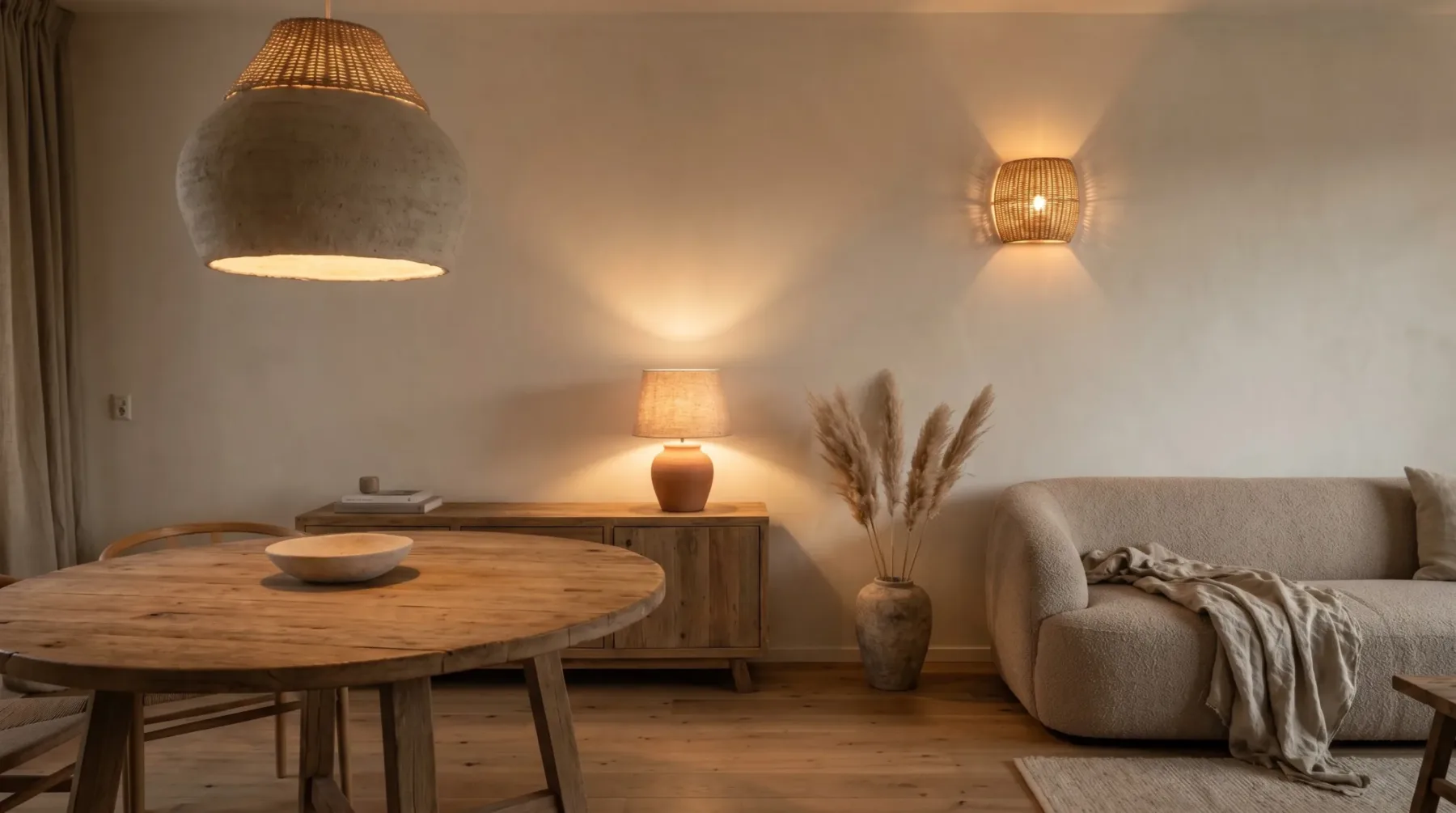
Professional Wabi-Sabi interiors rarely rely on a single light source. Instead, they layer three distinct functions, each assigned to a specific material and fixture type:
Layer 1 — Ambient (The Anchor)
A single large-scale fixture—typically a handcrafted ceramic pendant or a rough-textured plaster dome—establishes the room’s overall glow. It should sit low, cast light downward and outward, and never aim for uniform brightness. Diameter should scale to roughly one-third the width of the table or seating group it hangs above.
Layer 2 — Task (The Focus)
Table lamps and reading lights carry the functional load. A small terracotta or travertine base paired with a linen or pleated silk shade delivers focused light without glare. Position these at seated eye level minus 15-20cm to avoid direct bulb visibility.
Layer 3 — Accent (The Atmosphere)
Wall sconces and shadow-casting fixtures—raffia or perforated ceramic—exist purely for mood. Their job is to throw texture onto walls: dappled patterns, soft gradients, the visual “noise” that keeps a minimalist room from feeling sterile.
The rule of thumb for specifiers: no single layer should exceed 40% of the room’s total lumen output. This forces the eye to travel between pools of light, which is what creates the perceived depth and calm associated with Wabi-Sabi spaces.
3. Color Temperature: The Non-Negotiable Detail
Nothing breaks a Wabi-Sabi scheme faster than the wrong color temperature. Cool white (4000K+) reads as clinical and industrial—the opposite of what the aesthetic demands.
| Room Function | Recommended CCT | Rationale |
|---|---|---|
| Bedroom, tea room | 2700K | Promotes rest; mimics candlelight warmth |
| Living room, lounge | 2700–3000K | Balances relaxation with visual clarity |
| Dining area | 3000K | Flatters food and skin tones without harshness |
| Entryway, hallway | 3000K | Consistent transition from exterior light |
Beyond CCT, specify a high color-rendering index (CRI 90+) so that natural material tones—clay reds, oak grains, linen off-whites—render accurately rather than washing out under cheap LEDs.
4. Material Selection as a Lighting Decision
In Wabi-Sabi design, the fixture material is not just aesthetic—it is a photometric tool. Different materials interact with light in fundamentally different ways. When you are ready to compare suitable fixtures, browse our Wabi-Sabi pendant lighting collection:
- Unglazed ceramic and terracotta absorb and soften light, producing a warm, non-reflective glow ideal for ambient fixtures. See our deep dive on ceramic lighting aesthetics.
- Alabaster and travertine transmit light through their veined structure, creating a natural gradient effect no manufactured diffuser can replicate—explored further in our Alabaster Lighting guide.
- Pleated silk diffuses light evenly across its structured geometric surfaces, adding a layer of soft modernism to Japandi-adjacent Wabi-Sabi spaces—see our Silk & Pleated Lighting guide.
- Raffia and woven textures cast organic shadow patterns, best reserved for accent layers where natural visual texture is prioritized over high lumen output.
A well-specified project pairs at least two of these materials in the same room—never four or five, which dilutes the intended restraint.
5. Room-by-Room Application Checklist
Bedroom
One ceramic or pleated silk pendant hung 1.2–1.5m above the headboard zone (not directly over the pillow); two small terracotta or travertine bedside lamps at 2700K; avoid any accent layer that could disrupt sleep—dimmable ambient light only.
Living Room
One statement pendant or cluster as the anchor; a floor lamp with a linen shade beside the primary seating; one or two raffia wall sconces to activate an otherwise flat wall. Reference our note on what defines a true Wabi-Sabi lamp when auditing fixture choices for this space.
Dining Room
A cluster of two to three small ceramic or raffia pendants (rather than one oversized fixture) hung 70–80cm above the tabletop creates rhythm across a long table—ideal for both residential dining and boutique hospitality settings.
Entryway & Hospitality Lobbies
A single sculptural pendant sets the tone the moment guests enter. For commercial projects, this is the fixture worth the largest budget allocation—it is the first material story a guest encounters.
6. Common Specification Mistakes to Avoid
- Over-lighting. Wabi-Sabi rooms should feel slightly underlit by conventional standards—resist the instinct to add more fixtures for “safety.”
- Mixing cool and warm CCT in the same sightline. Even 500K differences between fixtures are visually jarring in a room built on tonal harmony.
- Choosing glossy or glazed finishes. Reflective surfaces reintroduce the industrial sheen Wabi-Sabi is designed to reject.
- Symmetry for its own sake. Perfectly matched fixture pairs can undercut the asymmetrical, hand-made quality that defines the style—slight variation between paired lamps is a feature, not a flaw.
Specify With Confidence
Wabi-Sabi lighting design rewards restraint and precision in equal measure. Get the layering, color temperature, and material pairing right, and the room does the rest—no styling tricks required.
OBBAO Lighting supports architects and hospitality specifiers with CE & RoHS-certified handcrafted ceramic, terracotta, travertine, and raffia fixtures, flexible customization, and low MOQs for trade projects. For a tailored lighting plan or bespoke specification sheet, contact our trade desk at frances@obbaolighting.com.